
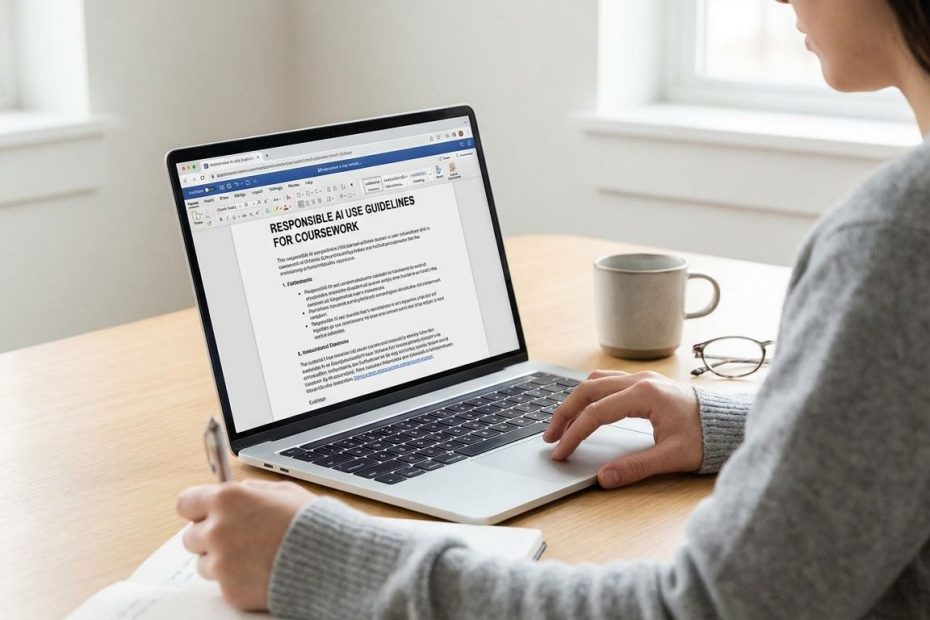
Responsible AI use in coursework means using artificial intelligence (AI) to support learning, not to replace your own thinking, writing, research, or problem-solving. You’re using it responsibly when you follow course rules, disclose or cite AI assistance when required, verify every output, and submit work you can explain in your own words.
Most students are already encountering AI in academic life, but course policies often vary from one professor to another. This guide helps you decide when AI is a useful study aid, when it crosses into academic misconduct, and how to protect your work, your skills, and your record.
Why Does Responsible AI Use In Coursework Matter Right Now?
Responsible AI use matters because AI tools are already part of student life, and many campuses still don’t give students clear rules. You need a practical way to make smart decisions before an assignment is due, not after a professor questions your work.
The Digital Education Council reported that most surveyed students globally use AI in their studies, and Inside Higher Ed reported that many college students in the United States have used generative AI for coursework. That means AI use is no longer rare or unusual. The harder part is knowing where assistance ends and substitution begins.
Policy gaps make this harder. Inside Higher Ed also reported that only a small share of colleges and universities had a formal student generative AI policy based on a survey of chief academic officers. When rules are missing, vague, or different across courses, you need your own safe defaults: read the syllabus, ask before using AI on graded work, keep records, and make sure the final submission is yours.
What Does Responsible AI Use Actually Mean?
Responsible AI use means you remain the author, thinker, and decision-maker. AI can help you plan, review, practice, or understand, but it should not complete the assignment for you unless your instructor has allowed that use.
A useful distinction is AI-assisted work versus AI-generated work. AI-assisted work could mean using a tool to brainstorm research angles, quiz yourself on a reading, check grammar, or ask for a simpler explanation of a difficult concept. AI-generated work means the tool produces paragraphs, answers, code, calculations, analysis, or creative material that you submit as if you made it yourself.
The safest standard is simple: if AI changed the substance of your submission, treat that help as something your instructor may need to know about. If you used AI only for spelling, punctuation, or formatting, some courses may not require disclosure, but you still need to follow your professor’s rules. When the policy is unclear, ask before submitting.
Is Using AI For Homework Considered Cheating?
Using AI for homework is cheating when it violates the assignment rules or hides work you didn’t do yourself. It is usually safer when AI supports studying, practice, or revision without replacing your own answer.
Many students get into trouble because they focus on the tool instead of the task. The same AI tool can be acceptable in one course and prohibited in another. A professor might allow AI for brainstorming a paper topic but ban it for writing a thesis statement, solving problem sets, producing code, or creating discussion board posts.
Use the assignment directions as your first boundary. If the assignment is meant to assess your writing, don’t let AI write the prose. If it is meant to assess your reasoning, don’t let AI build the argument. If it is meant to assess your research skills, don’t let AI invent or summarize sources without your verification.
How Can You Use AI To Study Without Breaking Academic Integrity Rules?
You can use AI safely by keeping it in a support role: study partner, practice coach, reading aid, or editing checker when allowed. The final reasoning, structure, claims, and voice should still come from you.
Good study uses include asking AI to explain a concept at a beginner level, create practice questions from your notes, compare two theories you already studied, or turn your own outline into a study checklist. These uses help you learn the material before you complete the assignment. They’re different from asking AI to write the answer and then copying it into your submission.
Build a simple habit before you use any AI tool: state your purpose. If your purpose is “help me understand,” “help me practice,” or “help me review,” you’re usually in safer territory. If your purpose is “finish this for me,” “make this sound like I read the material,” or “produce an answer I can submit,” stop and check the course policy first.
Can Professors Tell If You Used ChatGPT Or Another AI Tool?
Professors may suspect AI use from writing style, missing process work, weak source handling, or detector reports, but detection is not perfect. You should not rely on AI writing detectors as your main risk calculation.
Turnitin reported that its AI writing detection system reviewed a large volume of student papers and flagged many submissions for substantial AI-written content. That shows instructors may have access to AI-related signals, but a detector score is not the same as proof by itself. Your safest protection is transparent process work: notes, outlines, drafts, source records, and a clear explanation of how you used any tool.
False flags and unclear results are real student concerns. Your writing may look polished, formulaic, or different from past work for many reasons. Keep draft history and assignment notes so you can show your process if questions arise. Strong process records help protect honest work.
What Should You Do If Your School Has No Clear AI Policy?
If your school has no clear AI policy, use the strictest reasonable standard until your instructor clarifies the rules. Ask before using AI on graded work, and save the answer you receive.
Start with the course syllabus, assignment sheet, academic integrity office, department pages, library guidance, and writing center resources. Some institutions place AI rules under plagiarism, unauthorized assistance, technology use, or citation guidance rather than under a separate AI policy. If you can’t find a clear rule, don’t assume silence means permission.
A safe default is to avoid AI-generated text, calculations, code, analysis, or citations in final submissions unless permission is written in the course materials. You can still use AI for lower-risk learning tasks, like making flashcards from your own notes or asking for a plain-language explanation of a concept. If the work will be graded, get approval first.
How Should You Cite AI-Generated Content?
You should cite or disclose AI-generated content when your instructor, institution, or citation style requires it, or when AI directly shapes what appears in your submission. Citation does not make prohibited use acceptable, so permission comes before citation.
The American Psychological Association, Modern Language Association, and Chicago Manual of Style have published guidance for citing or acknowledging generative AI in academic work. The details differ by style, but the shared principle is transparency. If you quote, paraphrase, adapt, or rely on AI-generated material, your reader should be able to see that AI contributed.
Don’t confuse citation with accuracy. AI tools can produce false claims, fake sources, wrong dates, broken logic, and confident mistakes. If AI gives you a source, verify the source through your library database, textbook, course reading, or another accepted academic resource before you use it.
How Do You Talk To Professors About AI Use?
Talk to your professor before you submit the assignment, and be specific about the help you want from AI. Vague questions get vague answers, so ask about the exact task and tool use.
A strong email is short and practical. You can write: “I’m working on the research outline for the upcoming assignment. Is it allowed to use an AI tool to brainstorm possible subtopics if I write the outline myself and do not copy AI-generated text?” This shows that you want to learn, follow rules, and keep authorship clear.
If you already used AI and you’re unsure whether it was allowed, ask before turning in the work. Explain what the tool did, what you changed, and what parts are entirely yours. It is better to revise early than to defend a questionable submission later.
How Can You Avoid Becoming Too Dependent On AI?
You avoid AI dependency by using it after you’ve done your own thinking, not before. The easiest test is whether you can explain your work without opening the tool.
Set boundaries that protect your learning. Write your first thesis, first solution attempt, first outline, or first code logic without AI. Then use AI to check gaps, ask practice questions, or compare your reasoning against a different explanation. This keeps AI in the review stage instead of the creation stage.
Use human academic support too. Writing centers, librarians, tutors, teaching assistants, office hours, and study groups help you build skills AI can’t verify for you. If you notice that your assignments no longer sound like you, or you can’t defend your own choices, reduce AI use and rebuild the skill directly.
What Should You Watch Out For Before Submitting AI-Assisted Work?
Before submitting AI-assisted work, check permission, accuracy, citation, voice, and ownership. If any of those five areas are weak, revise before you turn it in.
Start with permission: does your syllabus allow the use you made? Then check accuracy: did you verify claims, sources, formulas, quotations, and reasoning? After that, check citation or disclosure rules. If AI contributed to the substance of the work, your professor may expect you to acknowledge it.
Read the final submission out loud and ask whether it sounds like your normal academic voice. AI writing can become generic, over-polished, or disconnected from your class materials. Your final work should reflect your understanding, your course readings, your assignment prompt, and your own choices.
What Is Responsible AI Use In Coursework?
- Use AI to support learning.
- Follow course rules.
- Disclose or cite AI help when required.
- Verify facts and sources.
- Submit work you understand and can defend.
Use AI As A Study Tool, Not A Substitute For Your Work
Responsible AI use in coursework comes down to authorship, transparency, and learning. You can use AI to clarify hard material, organize study time, test your understanding, and improve mechanics when your course allows it. You cross the line when the tool does the thinking, writing, analysis, or problem-solving that the assignment is meant to measure. When rules are unclear, ask early, keep records, and choose the safer option. The best use of AI leaves you better prepared to explain, revise, and defend your own work.
References
- Digital Education Council – Global AI Student Survey 2024
- Inside Higher Ed – Survey: 70% Of Students Have Used Generative AI For Coursework
- Turnitin – AI Writing Detection Update: One Year On
- Inside Higher Ed – Few Institutions Have A Formal AI Policy
- BestColleges – College Students And AI Tools Survey
- Chegg.org – Global Student Survey

Michael E Weintraub is an attorney and founder of the Law Office of Michael E. Weintraub, LLC in Neptune, NJ. With over 25 years of experience in trials, estate planning, and estate administration, he is known for delivering client-focused legal solutions with integrity and precision.