
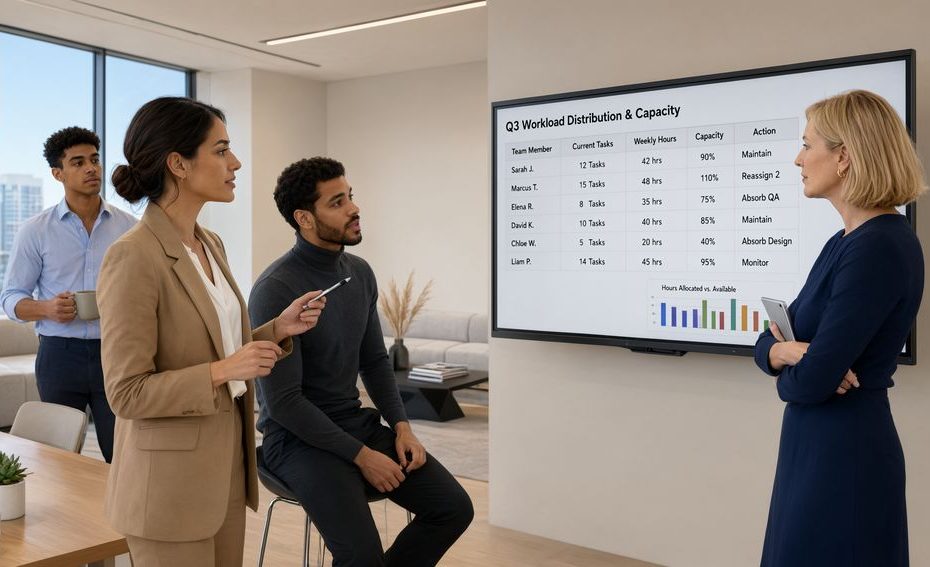
To divide team work without creating resentment, use fair workload distribution based on visible capacity, task demands, skills, and criteria everyone can understand. Let team members flag conflicts before assignments are confirmed, then review the balance as priorities and workloads change.
Resentment rarely comes from one difficult assignment. It grows when the same people keep absorbing extra work, unpopular tasks are distributed without explanation, or hidden responsibilities go unnoticed. A transparent process helps you assign work people can accept, even when everyone doesn’t receive an identical share.
Why Does Team Work Feel Unfair Even When It Looks Balanced?
Work feels unfair when the visible task list doesn’t reflect the effort, responsibility, or interruption behind each assignment. Two people may each receive five tasks, yet one person’s work could require more decisions, coordination, and follow-up. Counting assignments alone can hide a serious imbalance.
People also judge fairness by comparing their contributions and outcomes with those of their coworkers. When someone repeatedly handles urgent requests, corrects mistakes, or supports other team members without recognition, a balanced-looking task list can still feel unfair. The problem becomes harder to detect when that person is reliable and rarely complains.
Fairness also depends on the assignment process. People are more willing to accept difficult or unequal outcomes when they understand how decisions were made, have a chance to speak, and see the same rules applied across the team. A closed process invites assumptions about favoritism, convenience, or poor planning.
What Is The Difference Between Equal And Equitable Work Distribution?
Equal distribution gives each person the same amount of work. Equitable distribution considers task difficulty, available time, experience, decision pressure, deadlines, and current responsibilities before dividing the workload.
Equal hours don’t always produce a fair result. A routine administrative task may take longer than a familiar technical task, but the technical assignment may carry greater risk and require uninterrupted concentration. You need to compare the full demand of the work rather than rely on hours or task counts alone.
Equitable workload distribution also accounts for development. A newer employee may need extra time and support to complete an unfamiliar assignment, yet giving every difficult task to senior employees creates high performer burnout. You can protect delivery quality and build team capability by pairing stretch assignments with realistic deadlines, guidance, and a defined reviewer.
The goal isn’t to make every person’s workload identical each day. The goal is to make temporary imbalances visible, explain why they exist, and prevent them from becoming permanent. People can often accept a heavier week when they know the reason and can see when the workload will be adjusted.
What Causes Workloads To Become Lopsided?
Lopsided workloads often begin with hidden work. Meetings, messages, status updates, approvals, mentoring, troubleshooting, and task switching consume time but may never appear on the project plan. Asana has reported that knowledge workers spend about 58 percent of their time on coordination and other “work about work,” showing why a simple deliverables list can misrepresent real capacity.
High performers are also easy to overload. They respond quickly, need less supervision, and often volunteer when deadlines are tight. Research published by Harvard Business Review found that a small share of employees can carry a large amount of value-added collaboration, creating a pattern in which reliability is rewarded with additional demands.
Low visibility can create the opposite problem. The American Psychological Association describes social loafing as reduced individual effort when people work collectively rather than alone. When ownership and progress are unclear, missed work can blend into the group, leaving dependable employees to close the gaps.
Role ambiguity adds another source of imbalance. Two people may duplicate the same work because neither knows who owns it, or each person may assume the other will handle an overlooked task. Workload balancing improves when every meaningful deliverable has one named owner, a deadline, and a clear definition of completion.
How Should You Assess Capacity Before Assigning Tasks?
Assess capacity by reviewing current commitments, deadlines, recurring duties, expected effort, dependency load, and available focus time. Don’t ask only whether someone has space. Ask what they must pause, delay, or hand off to take on the new assignment.
Start with a shared view of active work. List major deliverables, routine responsibilities, pending approvals, support duties, and deadlines for every team member. Include less visible demands, including onboarding support, meeting preparation, client communication, quality checks, and recurring reporting.
Then estimate each assignment across several factors: time, difficulty, urgency, decision responsibility, coordination needs, and interruption risk. You don’t need a complicated scoring formula. A simple low, medium, or high rating can expose differences that a task count misses.
Review skills after checking capacity, not before. Assigning work to the most skilled person can protect short-term speed, but repeated dependence creates bottlenecks and resentment. When another team member has reasonable capacity, you can transfer the task with training, documentation, or a planned review point.
What Process And Tools Support Fair Workload Distribution?
A fair process starts with visible assignment criteria and a draft rather than a closed decision. Explain the priorities, show the work that must be covered, describe the criteria used, and invite people to identify missing commitments or unrealistic assumptions.
Build the draft assignment plan around business need, capacity, task demands, skills, development goals, and rotation history. Name one owner for each deliverable and identify anyone who must review, advise, or approve it. If one person receives a heavier share, record the reason and the point when the team will reassess it.
A Responsible, Accountable, Consulted, and Informed (RACI) matrix can clarify who completes the work, who owns the result, who provides input, and who needs updates. A team charter can define recurring responsibilities, response expectations, and rules for urgent requests. A workload dashboard can show active assignments, deadlines, estimated effort, and blocked work without turning visibility into surveillance.
Keep the tracking method proportional to the work. A small team may need only a shared board with owners, priorities, and due dates. A larger team may need capacity categories, dependency tracking, and weekly allocation reviews. The tool matters less than consistent use and honest updates.
How Do You Communicate Assignments Without Triggering Defensiveness?
Communicate assignments by explaining the reason, the expected result, the available support, and the tradeoffs. Avoid presenting a decision as fair merely because a manager made it. Let the employee see how the assignment fits the wider workload.
Use direct language: “You’re receiving this task because you have the required client knowledge, and another deadline has been moved to protect your capacity.” That message gives a reason and names the adjustment. “You’re good at this, so you can handle one more thing” sends the opposite message and can make competence feel like a penalty.
When assigning an unpopular task, acknowledge what makes it undesirable. Then explain whether it is rotating, tied to a specific role, or assigned according to current availability. If rotation would lower quality, pair the experienced owner with someone who can learn the work and share it later.
Invite factual corrections rather than vague approval. Ask, “What active commitment is missing from this plan?” or “Which deadline becomes unrealistic if you take this on?” These questions make it easier to discuss capacity without forcing someone to argue that the assignment is unfair.
What Should You Do When Someone Is Not Pulling Their Weight?
Address low contribution by confirming expectations, ownership, capacity, and obstacles before judging intent. A missed task can result from unclear responsibility, limited skill, conflicting priorities, weak follow-up, or deliberate avoidance, and each cause requires a different response.
Start with specific work rather than labels. Identify the assignment, agreed deadline, current status, and effect on other team members. Ask what blocked completion, then reset the owner, due date, support, and check-in point in writing.
Don’t quietly transfer unfinished work to a dependable employee every time. That protects the immediate deadline but teaches the team that accountability is optional and reliability attracts extra work. If reassignment is necessary, make it visible and record what will change before the next deadline.
Review workload patterns regularly rather than waiting for frustration to surface. Look for repeated overtime, stalled tasks, frequent rescue work, uneven rotation, and people who are routinely left out of meaningful assignments. Ask team members privately whether the current division feels workable and what hidden duties aren’t represented.
Old resentment may take time to reduce. Acknowledge the past imbalance without debating whether every complaint was justified, then implement visible rules and apply them consistently. Trust improves when people see that raised concerns lead to measurable changes in ownership, capacity, or deadlines.
How Do You Divide Team Work Fairly?
- Use visible assignment criteria.
- Match tasks to skills and capacity.
- Rotate unpopular responsibilities.
- Share the draft plan for input.
- Review workload balance regularly.
What Should Your Team Remember About Fair Delegation?
Fair workload distribution doesn’t require identical hours, task counts, or difficulty for every employee. It requires visible work, realistic capacity checks, clear ownership, explained decisions, and a reliable way to rebalance assignments. Protect high performers from becoming permanent rescuers, address missed commitments directly, and account for coordination work that ordinary task lists overlook. When people understand how decisions are made and can correct missing information, difficult assignments feel less arbitrary. A fair process won’t remove every disagreement, but it will stop hidden patterns from becoming accepted team habits.
Resources
- Harvard Business Review: Collaborative Overload
- Harvard Business Review: Fair Process, Managing in the Knowledge Economy
- American Psychological Association: Social Loafing
- Asana: Anatomy of Work
- Gallup: State of the Global Workplace
- Project Management Institute: Pulse Research
- Atlassian: Team Playbook.

Michael E Weintraub is an attorney and founder of the Law Office of Michael E. Weintraub, LLC in Neptune, NJ. With over 25 years of experience in trials, estate planning, and estate administration, he is known for delivering client-focused legal solutions with integrity and precision.