
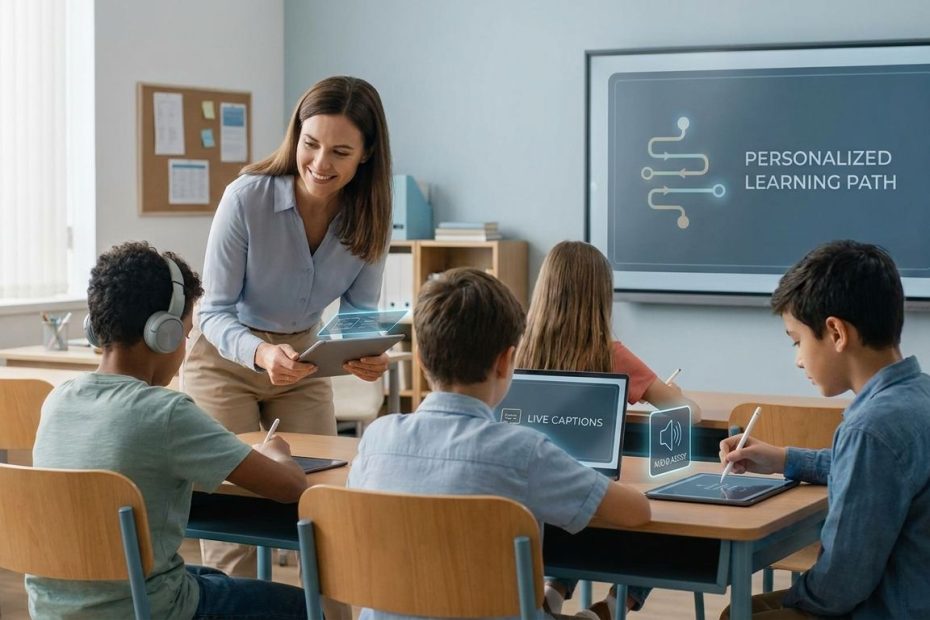
Artificial Intelligence (AI) can make education more inclusive by removing barriers that keep students from accessing the same content, tools, and classroom participation as their peers. The best use of ai for inclusive education supports the teacher’s work: captioning speech, adapting materials, translating language, personalizing practice, and helping students show what they know in more than one way.
A student who struggles to decode long passages may understand the lesson once text becomes audio. A deaf or hard-of-hearing student may join a discussion more easily when live captions appear in real time. A multilingual learner may need translated directions before they can begin the same assignment as everyone else. AI doesn’t solve every access problem, but it can reduce the daily friction that makes learning feel out of reach.
What Does Inclusive And Accessible Education Really Mean?
Inclusive and accessible education means you design learning so more students can participate from the start, not after they fall behind. You plan for different ways to read, listen, speak, move through content, practice skills, and show understanding.
Universal Design for Learning (UDL) is a useful way to think about this work. Instead of giving every learner the same format and calling it fair, you offer multiple paths to the same learning goal. One student may need captions, another may need audio, another may need simplified directions, and another may need a visual model before solving a problem independently.
AI fits this work when it removes a barrier without lowering the standard. A reading passage can become audio, a lecture can become searchable notes, and a teacher-created explanation can become a version written at a different reading level. You still choose the learning target, review the output, and decide whether the support matches the student’s needs.
The goal isn’t to label students by what they can’t do. The goal is to give each learner a fair route into the same academic work. That’s where ai for inclusive education becomes practical rather than flashy.
How Can AI Help Students With Disabilities?
AI can help students with disabilities by converting content into accessible formats and reducing the effort needed to enter, process, or express information. Common supports include speech-to-text, text-to-speech, image descriptions, live captions, reading assistance, and adaptive practice.
Speech recognition can turn a student’s spoken response into written text. That helps students who have difficulty typing, spelling, or organizing ideas on a keyboard. It can also support students with physical disabilities who need another way to produce written work.
Text-to-speech tools can read digital text aloud for students with dyslexia, visual impairments, attention challenges, or fatigue related to reading. This matters because reading access and content understanding are not always the same skill. If the lesson is about science, history, or math reasoning, audio access can help the student engage with the actual subject instead of getting stuck at the decoding stage.
AI-powered image and content description tools can also support blind and low-vision students. A chart, slide, photograph, or diagram needs meaningful description before it becomes useful. Automated descriptions should be checked by a teacher, but they can speed up the first draft of accessible learning materials.
What AI Tools Make Learning More Accessible Right Now?
The most useful tools right now are often the least dramatic: captions, transcription, translation, text-to-speech, reading support, and adaptive practice systems. They help because they solve common access problems during ordinary lessons.
Real-time captioning and transcription are among the fastest wins for accessibility. A teacher’s explanation, a class discussion, or a presentation can become text that students can read during or after the lesson. This helps deaf and hard-of-hearing students, students in noisy rooms, students who process language more slowly, and students who need notes they can review later.
Translation tools can support English language learners and families who speak another home language. They can translate directions, messages, and classroom materials fast enough to keep students involved in the task. A teacher still needs to review tone, accuracy, and subject-specific words, but instant translation can reduce the delay that often separates multilingual learners from the rest of the class.
Reading and writing tools can simplify directions, define vocabulary, suggest sentence starts, or read passages aloud. These supports are most useful when you connect them to a clear goal. If the goal is argument writing, AI can help a student organize claims and evidence; if the goal is independent reading stamina, the teacher may choose a lighter level of support.
Can AI Personalize Learning For Neurodiverse Students?
AI can personalize learning for neurodiverse students by adjusting pacing, feedback, practice difficulty, and content format. It works best when the teacher reviews the recommendations and connects them to the student’s learning plan.
Adaptive learning platforms can change the sequence of questions based on how a student responds. If a learner misses several problems using the same concept, the system can provide a shorter step, a hint, or more practice before moving forward. If a student shows mastery, it can offer more advanced work without forcing them to repeat what they already know.
For students with attention differences, autism, dyslexia, language processing needs, or working-memory challenges, pacing and format matter. A long text block can become smaller chunks. A written explanation can become audio. A math process can be broken into steps with immediate feedback after each move.
Personalization still needs boundaries. Too much automation can isolate a student from peer discussion or teacher feedback. You get better results when AI handles repeated practice and format changes, then the teacher uses that information to plan small-group instruction, check understanding, and build confidence.
How Does AI Help Teachers Without Replacing Them?
AI helps teachers by reducing time spent on repetitive access tasks, so they can focus on instruction, relationships, and judgment. It can draft captions, adjust reading levels, generate practice items, summarize notes, and suggest ways to differentiate a lesson.
A teacher with a full class may need three versions of directions, vocabulary support for English language learners, audio access for a student with dyslexia, and extension work for students ready to move ahead. AI can prepare first drafts of those supports faster than a teacher working from a blank page. The teacher then checks accuracy, removes errors, and adapts the material for the actual students in the room.
This is where human judgment matters most. AI does not know a student’s history, confidence, frustration level, family input, or social needs unless someone provides that information. It can recommend a reading level, but it can’t decide whether the student needs encouragement, a different partner, a quiet space, or a conversation after class.
Educational agencies have stressed that AI should support professional judgment rather than replace it. That is the right standard for inclusive classrooms. Teachers set the purpose, specialists guide accommodations, families share student needs, and AI helps produce accessible options faster.
What Risks Should Schools Manage Before Using AI?
Schools should manage bias, privacy, unequal access, over-reliance, and weak customization before using AI with students. These risks don’t mean you should avoid AI; they mean you need clear rules and careful review.
Bias can appear when tools are trained on data that does not represent the students using them. A speech tool may struggle with atypical speech, accents, or language patterns. A reading tool may give poor recommendations if it confuses language development with a learning disability.
Privacy also matters. Accessibility tools may process student speech, writing samples, learning profiles, disability-related information, or performance data. Schools need to know what data is collected, where it goes, who can see it, and how long it is stored. A tool that creates convenience but exposes sensitive student information is not a good trade.
The digital divide can also turn AI into another advantage for students who already have more support. If one school has reliable devices, connectivity, and trained staff, and another does not, the gap can grow. Inclusive AI planning has to include device access, internet access, teacher training, and low-cost alternatives.
How Can Schools Prepare Teachers To Use AI Inclusively?
Schools can prepare teachers by training them to choose tools, check outputs, protect student data, and match AI supports to learning goals. Training should be practical, short enough to use, and tied to real classroom tasks.
Many teachers do not need a theory-heavy introduction to AI before they can start using it well. They need to know which tools are approved, which student needs they support, and what mistakes to watch for. A useful training session might focus on turning a worksheet into an accessible digital version, creating captions for a lesson video, or adapting reading material without changing the academic goal.
Teachers also need shared decision rules. When should AI-generated text be edited? When should a translation be checked by a fluent speaker? When should a student use speech-to-text for writing, and when should they practice keyboarding or handwriting? These decisions work better when teachers, accessibility specialists, school leaders, and families use the same expectations.
Professional learning should include assistive technology basics, Universal Design for Learning (UDL), disability access, multilingual learning, and data safety. That mix keeps AI from becoming a random add-on. It becomes part of the school’s normal accessibility practice.
Is AI For Inclusive Education Only For Well-Funded Schools?
No, ai for inclusive education is not only for well-funded schools, but access depends on planning, training, devices, and connectivity. Free or built-in tools can help, yet schools still need time and support to use them well.
Many accessibility features are already included in common devices, browsers, presentation tools, and mobile applications. Live captions, voice typing, screen reading, translation, and text-to-speech may be available without buying a separate platform. The cost problem often comes from implementation: staff training, device availability, reliable internet, and technical support.
Schools with tighter budgets can start with the barriers students face most often. If students miss spoken directions, start with captions and transcripts. If students struggle to read grade-level text, start with text-to-speech and vocabulary support. If families need communication in multiple languages, start with translation tools and a review process for important messages.
The safest starting point is narrow and measurable. Pick one access problem, choose an approved tool, train staff on that tool, and review whether students use it successfully. Scaling AI before teachers and students are ready can waste money and create confusion.
What’s Next For Accessible Learning With AI?
The future of accessible learning will likely include better multimodal tools, stronger personalization, more accurate translation, and richer support for students who need visual, auditory, or cognitive access. The most useful systems will still need teacher review and inclusive design from the start.
Emerging tools may describe images, convert math notation into spoken explanations, adapt content across reading levels, and provide guided practice in real time. Research projects have also explored emotion recognition tools for some students with autism, though these tools need careful limits and review. Any system that interprets a student’s feelings, attention, or behavior can create errors if used without professional judgment.
Better AI could also help teachers create accessible materials before students ask for accommodations. A lesson slide deck could include captions, alt text, simplified summaries, vocabulary support, and translated family notes from the beginning. That saves time and reduces the stigma students may feel when they must request a separate version.
The strongest future is not a classroom run by software. It is a classroom where more students can enter the lesson, stay with the work, and express understanding in ways that match their needs. AI earns its place when it helps you do that with care and consistency.
How Does AI Make Education More Inclusive?
- Live captions for spoken lessons
- Text-to-speech for reading access
- Adaptive practice for learning needs
- Translation for multilingual learners
- Image descriptions for visual access
Build Access Before You Buy More Technology
Artificial Intelligence can support inclusive education when you use it to solve real access barriers, not chase the newest tool. Start with the student need, then choose the feature: captions for spoken language, text-to-speech for reading access, translation for language support, adaptive practice for skill gaps, and content descriptions for visual access. Keep teachers in charge of decisions, review AI output before students depend on it, and protect sensitive student data from the start. The best results come when AI is part of a larger accessibility plan that includes training, family input, assistive technology, and Universal Design for Learning (UDL). If the tool helps more students participate in the same learning with dignity, it’s moving in the right direction.
References
- UNESCO – Artificial Intelligence In Education
- U.S. Department Of Education – Artificial Intelligence And The Future Of Teaching And Learning
- Microsoft – AI For Accessibility
- Google Accessibility
- Education Week – Teachers Are Confronting AI And It’s A Steep Learning Curve
- Market.us – AI In Education Market Size
- Journal Of Special Education Technology
- MIT Media Lab – Emotion Recognition Research For Autism.

Michael E Weintraub is an attorney and founder of the Law Office of Michael E. Weintraub, LLC in Neptune, NJ. With over 25 years of experience in trials, estate planning, and estate administration, he is known for delivering client-focused legal solutions with integrity and precision.