
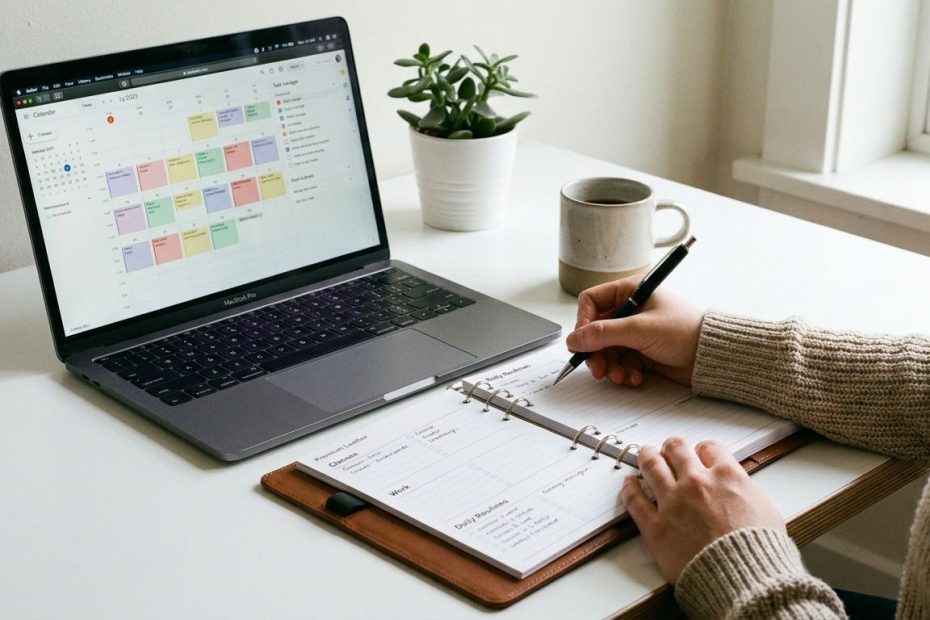
Simple productivity habits for balancing classes, work, and life help you protect your time, focus your attention, and recover enough energy to keep going without turning your schedule into another full-time job.
If you’re working, studying, commuting, keeping up with relationships, and trying to stay healthy, the goal isn’t to squeeze more into every hour. The goal is to reduce friction: fewer decisions, fewer distractions, and fewer unrealistic plans that collapse after one busy week. This guide gives you small habits you can use even when your schedule changes, your energy dips, or your day doesn’t go as planned.
The Reality Check: Why Your Schedule Feels Impossible
Your schedule feels hard because it probably is. Many undergraduate students work while enrolled, and part-time students are especially likely to hold jobs. That means your attention is split across class deadlines, work shifts, transportation, meals, sleep, and personal responsibilities before you even think about studying well.
Stress also stacks up fast when school and work compete for the same hours. The American Psychological Association has reported that many young adults rate their mental health as fair or poor, with money, work, and school among the main stressors. Gallup has also reported elevated stress among workers, which matters if you’re trying to perform well at work and still show up prepared for class.
Traditional productivity advice often assumes you control most of your day. You may not. A better plan respects real constraints: shift changes, group projects, family needs, traffic, fatigue, and days when your brain refuses to cooperate. Your system should bend without breaking.
Stop Managing Time, Start Managing Energy
Time management for students only works when you pair it with energy management. Two free hours after a long shift don’t have the same value as two alert hours before work. Treat your energy like a resource you assign carefully, not a bonus that appears on demand.
Start by noticing when your mind is sharpest. Some people focus better early, some hit their stride later, and some get one good window between obligations. Use that window for the work that needs real thinking: writing, problem sets, exam review, research, or planning a presentation. Save easier tasks for low-energy periods, including laundry, email, file cleanup, flashcard review, or routine reading.
This habit protects you from wasting your best attention on small administrative tasks. If your strongest hour gets spent clearing notifications, your hardest schoolwork gets pushed into the part of the day when you’re already tired. A simple rule helps: put your hardest class task into your best available energy window, even if that window is only thirty minutes.
The 15-Minute Weekly Compass
A weekly plan should help you decide what matters, not become a polished calendar you feel guilty about ignoring. Set one short planning block before your week begins or before your busiest stretch. Fifteen minutes is enough if you focus on choices, not decoration.
Start with your fixed commitments: classes, work shifts, commute time, appointments, and immovable deadlines. Then choose three school priorities and three life or work priorities for the week. These should be specific enough to act on, such as finishing a lab draft, reviewing two chapters, submitting a timesheet, buying groceries, or calling someone you’ve been meaning to reach.
Leave open space on purpose. If every hour is booked, one delay can wreck the whole plan. Add buffer time around work, classes, and demanding study blocks. Your calendar should show reality, not an ideal version of you who never gets tired or interrupted.
Micro-Habits That Actually Stick
Micro-habits work because they lower the starting line. When you’re busy, the hardest part is often beginning. A two-minute version of a task can break the freeze without requiring a burst of motivation.
Use tiny starts that naturally lead into longer work. Open the document and write one rough sentence. Put your textbook on the desk. Review five flashcards. Pack your bag before bed. Add tomorrow’s work shirt to the same chair as your backpack. These actions look small, but they remove morning decisions and reduce the chance that one forgotten item derails your day.
Habit stacking makes this easier. Attach a school habit to something you already do: after breakfast, check your class platform; after clocking out, review tomorrow’s deadline list; after brushing your teeth, set your bag by the door. The habit doesn’t need to feel impressive. It needs to repeat.
Single-Tasking: Doing One Thing Well When Life Demands Everything
Multitasking feels efficient because you’re busy, but busy isn’t the same as productive. Research on interrupted work shows that interruptions can create extra stress and make it harder to return to the original task. Cognitive research also links multitasking with reduced productivity, especially when tasks require attention and memory.
Use single-tasking blocks when you need to study, write, solve, or memorize. Pick one task, set a timer, and remove every avoidable distraction from your reach. The Pomodoro Technique can work well here: focus for a short timed block, then take a brief break. You don’t need to follow it perfectly. The value comes from making one task the default until the timer ends.
For class and work balance, single-tasking also reduces mental residue. If you answer work messages during study time, your brain keeps switching roles. If you check coursework during a meal with a friend, you never fully recover. Give each block a clear job: study, work, rest, commute, clean up, connect, or sleep.
Strategic Neglect And The Power Of Saying No
Balancing classes, work, and life requires choosing what won’t get premium attention. Strategic neglect means you intentionally reduce, delay, delegate, or simplify low-impact tasks so your limited energy goes where it pays off. This is not laziness. It’s a survival skill for packed weeks.
Look for tasks that consume time without moving your grades, income, health, or relationships forward. A perfect color-coded study guide may matter less than doing practice questions. Rewriting notes for hours may matter less than testing yourself. Saying yes to every extra shift may matter less than protecting one study block before an exam.
Use a simple filter: must do, should do, can wait, can skip. Must-do tasks have real consequences. Should-do tasks help, but they can shrink when the week gets tight. Can-wait tasks move to a later date. Can-skip tasks leave your list without guilt.
Design A Digital Environment That Works For You, Not Against You
Your phone can support your schedule, but it can also shred your attention into pieces. Notification management is one of the fastest productivity wins because it removes temptations before you need willpower. If every app can interrupt you, your study plan is competing with your entire digital life.
Start with your lock screen. Turn off non-urgent notifications during class, study blocks, meals, and sleep. Use focus settings, app limits, website blockers, or a separate study profile if your device supports it. Keep only the tools you need visible during work sessions: calendar, notes, learning platform, calculator, document editor, or timer.
Productivity apps for students can help, but don’t collect apps as a substitute for decisions. A basic calendar, one task list, and one place for class notes is enough for most people. Google Calendar, Apple Calendar, Microsoft To Do, Todoist, Notion, or a paper planner can all work if you actually check them. The best system is the one you trust on a messy Tuesday.
Self-Care Is Not A Reward, It’s The Fuel
Self-care is often treated like something you earn after finishing everything else. That fails when everything else never ends. Sleep, movement, food, and breaks are part of your productivity system because your brain and body set the limit on what you can sustain.
The Centers for Disease Control and Prevention reports that many adults sleep less than seven hours per night, and short sleep is linked with worse health and poorer functioning. For a working student, sleep debt shows up as slower reading, weaker memory, irritability, missed details, and lower patience. Protecting sleep may feel like losing time, but it often gives you better use of the hours you keep.
Keep self-care small enough to survive busy weeks. Ten minutes outside, a real meal instead of skipping food, stretching between classes, a water bottle in your bag, a walk after work, or a short reset before studying can change the quality of your next block. You don’t need a perfect wellness routine. You need repeatable recovery.
Reflect And Adapt With A 5-Minute Evening Shutdown
An evening shutdown helps you stop carrying every unfinished task in your head. Spend five minutes closing the day, not judging it. This habit works best when it’s short, plain, and repeatable.
Write down what got done, what still matters, and the first task for tomorrow. If something went wrong, name the cause without turning it into a character flaw. Maybe the task was too big, the study block was too late, notifications stayed on, or your commute drained more energy than expected. That information helps you adjust the system.
End with one physical reset. Pack your bag, clear your desk, plug in your laptop, set out clothes, or move tomorrow’s book to the table. This creates a visible cue for your next start. You wake up with less guessing and fewer small decisions pulling at your attention.
Build A Realistic Daily Routine For Work And Classes
A realistic daily routine is not a minute-by-minute script. It’s a sequence of anchors that keep your day from scattering. Anchors are repeatable points in the day: wake-up, commute, first class, work shift, meal, study block, shutdown, and bedtime.
Use anchors instead of strict timelines when your schedule changes often. If your shift ends at different times, attach your study habit to “after dinner” or “after arriving home” instead of one exact hour. If mornings are unpredictable, create a short launch routine: check calendar, pack food, confirm the top task, leave on time. Keep it boring. Boring routines save energy.
Protect one daily non-negotiable that supports everything else. It may be sleep, a thirty-minute study block, a meal, or a short reset between work and class. You can’t protect every priority every day. Protecting one keeps your routine from becoming all-or-nothing.
Use Simple Productivity Habits For Balancing Classes, Work, And Life Without Perfectionism
Perfectionism often disguises itself as high standards. In a packed schedule, it can become avoidance. If a task has to be done perfectly, starting feels risky, so you wait for a better mood, a longer block, or a cleaner desk. The better move is to lower the first draft standard and raise the follow-through standard.
Use “good enough for the next step” as your rule. A rough outline is good enough before a paper draft. A messy set of practice problems is good enough before a review session. A short email is good enough before you lose another day delaying it. Finished useful work beats polished imaginary work.
When you fall behind, restart smaller. Don’t rebuild your whole life on Sunday night. Choose one class task, one work task, and one recovery task for the next day. Simple productivity habits for balancing classes, work, and life work because they’re forgiving. You can return to them after a hard week without needing a fresh identity or a brand-new planner.
Simple Habits For Class And Work Balance
- Plan your week in 15 minutes.
- Match hard work to peak energy.
- Study in focused blocks.
- Silence distractions.
- Protect sleep.
Make Balance Easier To Repeat
Balancing classes, work, and life gets easier when your habits reduce decisions instead of adding pressure. Start with your energy, choose weekly priorities, work in focused blocks, and cut low-value tasks before they crowd out the work that matters. Protect sleep and recovery as part of the system, not as prizes for perfect performance. Your schedule may stay busy, but it can feel less chaotic when your next step is obvious. Keep the habits small enough to repeat, and you’ll build a routine that holds up in real life.
References
- National Center for Education Statistics: College Student Employment
- American Psychological Association: Stress In America
- Gallup: State Of The Global Workplace
- Centers For Disease Control And Prevention: Adult Sleep Facts
- University Of California, Irvine: Gloria Mark Interruption Research
- American Psychological Association PsycNet: Implementation Intentions Research
- Daniel Pink: When

Michael E Weintraub is an attorney and founder of the Law Office of Michael E. Weintraub, LLC in Neptune, NJ. With over 25 years of experience in trials, estate planning, and estate administration, he is known for delivering client-focused legal solutions with integrity and precision.