
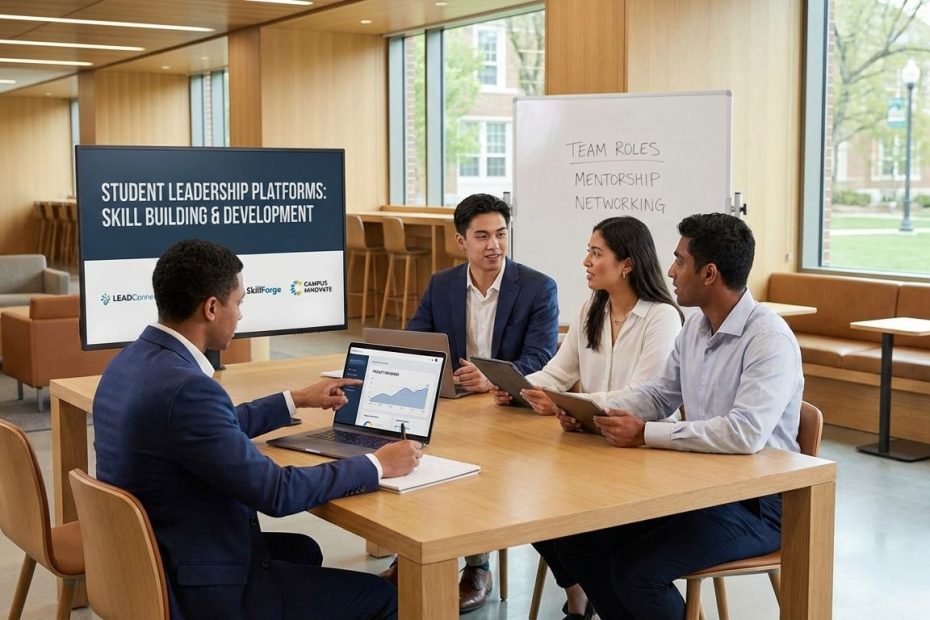
Student leadership development is the repeatable process of building the habits that let you set direction, earn trust, run decisions, and deliver results with other people watching. The right platform helps you practice those behaviors with structure, feedback, and proof you can show on applications, internships, and early-career resumes.
This guide helps you pick the right platform for your goals, timeline, and budget, then use it to produce outcomes you can document. You will also get a practical way to convert “learning” into measurable leadership performance: clearer communication, better meetings, stronger teamwork, and a portfolio of artifacts that hiring managers and admissions reviewers can verify.
1. Coursera: Leadership Courses With University-Backed Structure
Coursera works best when you want leadership training that feels like a real course, not a motivational playlist. You get a defined syllabus, assessments, and a sequence that builds from basics (communication, decision-making, emotional intelligence) to execution (team leadership, change, conflict). That structure matters when school is busy and you need a plan that does not depend on willpower.
Use Coursera as a “depth platform.” Pick one leadership course, finish it fast, then apply one concept the same week in a real setting you already have: a class project, lab group, student org, volunteer role, or part-time job. Track the before-and-after in writing, keep the meeting agenda you ran, keep the slide deck you presented, and capture a result that can be stated in one sentence.
Coursera also fits when you need a recognizable credential line on a resume, paired with proof. A certificate without application reads like interest, not capability. Pair the credential with a short portfolio note: what you improved, how you measured it, and what you would do differently next time.
2. edX: Academic-Style Learning From Recognizable Institutions
edX is a strong choice when your learning style matches academic coursework and you want leadership content delivered through a more classroom-oriented format. It tends to attract students who value rigor, readings, and a course experience that resembles university learning. That makes edX a good fit when you want leadership training that does not feel watered down.
Use edX when you need your leadership development to stand up to scrutiny from faculty reviewers, competitive programs, or scholarship committees. The move is to finish the course, then turn the capstone concepts into a campus execution plan. If the course covers team dynamics, run a team charter for your club. If it covers decision-making, formalize a decision log for your project group and show how it reduced rework.
edX also pairs well with leadership roles that already have accountability. If you already serve as a treasurer, committee lead, resident assistant, peer mentor, or team lead for a competition group, you can use edX to upgrade how you operate. You do not need a bigger title, you need cleaner execution and a record of results.
3. LinkedIn Learning: Fast Skill Sprints You Can Apply This Week
LinkedIn Learning is built for speed. When you need a practical answer to “How do you run a 30-minute meeting that gets decisions?” or “How do you give feedback without creating tension?” a targeted course gets you moving in one sitting. That makes it ideal for students balancing heavy course loads who still want leadership progress every week.
Use LinkedIn Learning as a “performance support” platform. Select one micro-skill, learn it, then apply it immediately. The fastest wins come from communication basics: agenda discipline, status updates, role clarity, follow-through, and conflict prevention through expectations. When students say they want leadership experience, what reviewers often want is evidence that you can drive these basics without dropping the ball.
Community discussions often treat LinkedIn Learning as useful for learning, but not always powerful as a standalone credential. That aligns with how hiring works early on: learning is respected, proof is trusted. Treat the courses as a skill gym, then bring receipts: a before-and-after meeting cadence, a short reflection, and a measurable output delivered by your team.
4. IBM SkillsBuild: Free, Career-Connected Skill Building With Project Energy
IBM SkillsBuild belongs on a student leadership list because leadership is not limited to managing people. You lead projects, lead processes, lead problem-solving, and lead delivery. SkillsBuild helps you build job-relevant capability that supports project leadership: digital literacy, workplace skills, and credentials that map to employability.
This platform is a strong pick when you need free or low-cost learning with a recognizable industry name behind it. That brand association matters for students without much experience, since you are borrowing trust while you build your own. It also suits students who want to pair leadership with practical fields like technology, operations, analytics, or digital project work.
Use SkillsBuild to produce portfolio work. Convert course learning into a small, finished deliverable: a process map for a club, a simple dashboard for event attendance, a volunteer scheduling system, a structured training checklist for new members. When you can show what you built and how it improved a result, leadership becomes concrete.
5. Gallup CliftonStrengths For Students: Strengths Language That Improves Teamwork
CliftonStrengths for Students gives you a structured way to understand how you naturally contribute, how you derail under stress, and how to communicate your working style to teammates. It is not a leadership replacement. It is a leadership amplifier, since self-awareness reduces friction and speeds up collaboration.
Many students take an assessment and stop there. That wastes the real value. Use the results to set operating rules: what you do best, what you need from others, and what you do when deadlines hit. Bring this into your club or project group as a short “how to work with me” statement. Your teammates will thank you, and your outcomes will improve.
Gallup’s guidance emphasizes that strengths work sticks when it becomes repeated conversations and real application, not a one-time quiz. Build a monthly strengths check-in with your team, tie strengths to tasks, and request feedback on one behavior you are practicing. This produces leadership growth you can describe in plain language during interviews.
6. Blanchard Institute Student Self Leadership: Cohort Accountability For Teens
If you do best when someone holds you accountable, a cohort-based experience can beat a self-paced library. Blanchard Institute’s Student Self Leadership program is designed to give students a guided experience with live sessions and structured work. That format helps you finish what you start, which is a leadership skill on its own.
Use this option when you are in high school or early college and need a defined start and finish. A time-boxed program can be easier to complete than open-ended platforms where “someday” becomes “never.” If the program includes assignments or activities, keep them organized and convert them into an outcomes folder you can reuse in applications.
This program can also help students who have potential but lack repetition. Leadership confidence often comes from doing simple behaviors consistently: showing up prepared, communicating early, setting boundaries, and delivering on deadlines. A facilitated environment accelerates that repetition, which turns effort into a track record.
How To Choose The Right Platform Without Wasting Time Or Money
Pick your platform based on the output you need in the next 30 to 90 days. If you need a structured credential and deeper coursework, choose Coursera or edX. If you need quick skill improvement you can apply this week, choose LinkedIn Learning. If the budget is tight and you want career-connected skill building, choose IBM SkillsBuild. If your team struggles with communication and role clarity, choose CliftonStrengths. If you need accountability and a guided schedule, choose Blanchard.
Then apply one rule: do not enroll in more than one primary platform at a time. Students over-enroll, under-finish, and end up with scattered effort that produces no proof. One platform, one goal, one deliverable. When that deliverable is done, move to the next.
Also define what “success” means before you start. Good leadership outcomes are measurable: meeting attendance improves, deadlines stop slipping, a process gets documented, a project gets shipped, conflict drops, members stay engaged, a new initiative launches on time. Tie learning to one measurable improvement and you will stand out fast.
How To Turn Courses Into Leadership Proof Employers And Schools Respect
Proof beats claims. A certificate shows effort, but leadership is evaluated through outcomes and behavior. Convert every course into artifacts: agendas, notes, decision logs, project plans, feedback requests, training checklists, and results summaries. Save them in a folder, then select two or three that represent real impact.
Write a short performance summary for each artifact using a simple format: your role, the goal, what you changed, what improved, and what you learned. Keep it tight and measurable. This becomes resume bullet fuel, interview stories, and application content without guessing what to say.
Use references when possible. If you led a student org initiative, ask a faculty advisor, supervisor, or team member to confirm the work in a short recommendation or LinkedIn note. Leadership is social proof, and third-party validation raises trust fast.
What To Watch For With Paid “Honor Society” Invitations And Leadership Memberships
Students regularly receive invitations that sound prestigious, then find a paywall and upsells. Community threads often describe NSLS invitations as scam-like or not worth the fee, pointing to expensive membership costs and limited real value. That does not mean every membership is useless, it means you must evaluate it like a buyer who protects time and money.
Use a practical checklist before paying. Confirm what you receive, what you produce, and what you can verify. Ask whether your campus chapter is active with real meetings and real advisors. Ask what outcomes members actually get: internships, mentorship, scholarships, leadership roles, measurable projects. If the value is vague, assume it will stay vague after you pay.
If a membership does not create concrete artifacts or verified outcomes, redirect that money into tools that do: a strengths assessment you will apply, a course sequence you will finish, or a program with live accountability. Leadership growth comes from consistent execution, not from paying for a title.
Best Platforms For Student Leadership Development
- Coursera, edX, LinkedIn Learning
- IBM SkillsBuild
- Gallup CliftonStrengths for Students
- Blanchard Student Self Leadership
Build Your Leadership Plan And Ship Real Results
Pick one platform that matches your goal, then schedule a finish date you will honor. Use what you learn to improve one real team outcome: a cleaner meeting system, a finished project, a documented process, or a measurable event result. Save artifacts, write short performance summaries, and collect one external validation from an advisor or supervisor. Rotate platforms only after you have proof in hand, and your leadership story will read like execution, not ambition.
References
- Coursera: Leadership Course Page
- edX (Wikipedia)
- LinkedIn Learning: Leadership Skills
- IBM SkillsBuild (Wikipedia)
- Gallup: CliftonStrengths for Students
- Gallup: Students Discovered Their CliftonStrengths
- University of Tennessee: Strengths for Students
- Blanchard Institute: Student Self Leadership
- NSLS: About the Program
- Reddit: NSLS Honor Society Thread
- Reddit: LinkedIn Courses Value Thread
- Reddit: ApplyingToCollege Courses Thread

Michael E Weintraub is an attorney and founder of the Law Office of Michael E. Weintraub, LLC in Neptune, NJ. With over 25 years of experience in trials, estate planning, and estate administration, he is known for delivering client-focused legal solutions with integrity and precision.